
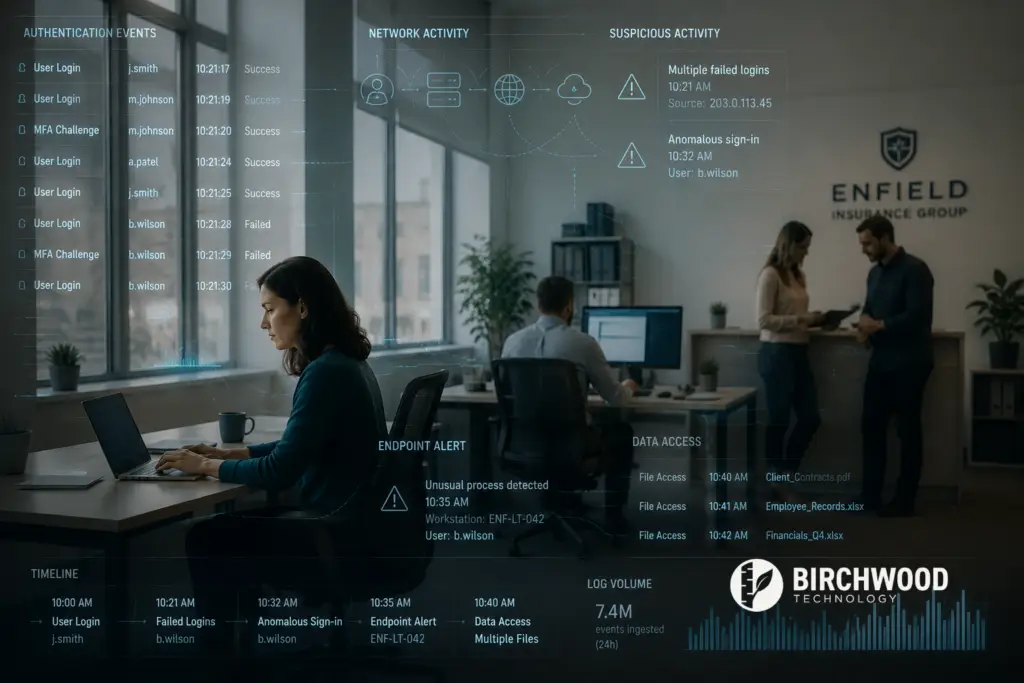
One of the things I insist on for every managed client, even very small businesses, is a SIEM.
That includes businesses with 3 employees.
Not because it sounds impressive. Not because it checks a compliance box. And not because it’s the latest cybersecurity buzzword.
Because if something goes wrong and you do not have logs, you do not have answers.
Most businesses think cybersecurity means antivirus, MFA, backups, maybe some email filtering. Those things matter. But what a lot of people do not realize is that modern cybersecurity is also about visibility.
When an incident happens, the first question is usually not “How do we stop it?”
It is:
“What happened?”
And without centralized logging and visibility, the honest answer is often:
“We don’t know.”
That is a terrifying place to be as a business owner.
SIEM stands for Security Information and Event Management.
In plain English, it is a centralized system that collects and analyzes security-related activity from across your environment.
Devices.
User logins.
Applications.
Firewalls.
Cloud platforms.
Security tools.
Identity systems.
Think of it like a flight recorder or security camera system for your technology environment.
It ingests massive amounts of information constantly. Most of it is noise. But buried in that noise are the clues that tell the story of what is happening inside a network.
That story becomes critically important during an investigation.
One thing I strongly disagree with in the IT industry is treating real cybersecurity as a luxury add-on.
A lot of businesses are sold fragmented solutions:
antivirus from one vendor
firewall from another
random monitoring tools
maybe backups
maybe MFA
no centralized visibility
Then SIEM gets positioned as some expensive enterprise feature reserved for giant corporations.
I think that mindset is outdated.
Cybersecurity is not a menu where you casually skip foundational pieces because the business is “too small.”
Threat actors do not care if your company has 3 employees or 3,000.
In many cases, smaller businesses are easier targets precisely because they lack visibility and mature protections.
Let’s say a vulnerable application on a workstation is exploited.
An attacker gets access quietly.
Maybe they steal credentials.
Maybe they move laterally to another machine.
Maybe they access email.
Maybe they establish persistence and sit there for weeks.
Without logs and centralized visibility:
you may never know how they got in
you may never know what systems were touched
you may never know how long they were there
you may never know whether they are actually gone
You are essentially guessing.
And that is the part many businesses never hear during sales conversations.
Cybersecurity is not just prevention anymore.
It is detection.
Investigation.
Response.
Evidence.
Context.
A SIEM does not magically stop every attack. Nothing does.
But it gives you the ability to reconstruct events and understand what actually happened instead of operating blindly.
This is also one reason cyber insurance carriers and compliance frameworks increasingly care about logging and monitoring.
Because during a claim or forensic investigation, evidence matters.
“We think nothing happened” is not evidence.
If there are no logs, investigators are left trying to piece together an incident with incomplete information. That makes remediation harder, increases uncertainty, and can make it difficult to confidently say the threat has been contained.
This is why I require SIEM for every managed client.
Not as an add-on.
Not as an upsell.
Not as some elite enterprise feature.
As a baseline requirement.
Because I do not think it is responsible to claim you are seriously protecting a business while operating with little or no visibility into what is happening in the environment.
Modern cybersecurity without visibility is guesswork.
And if you don’t have logs, you don’t have answers.